FORGE
The air-gapped coding copilot.
A sealed appliance that reads your repositories, indexes them locally, and answers from a model that never leaves the building. No proprietary source ever reaches a public LLM.
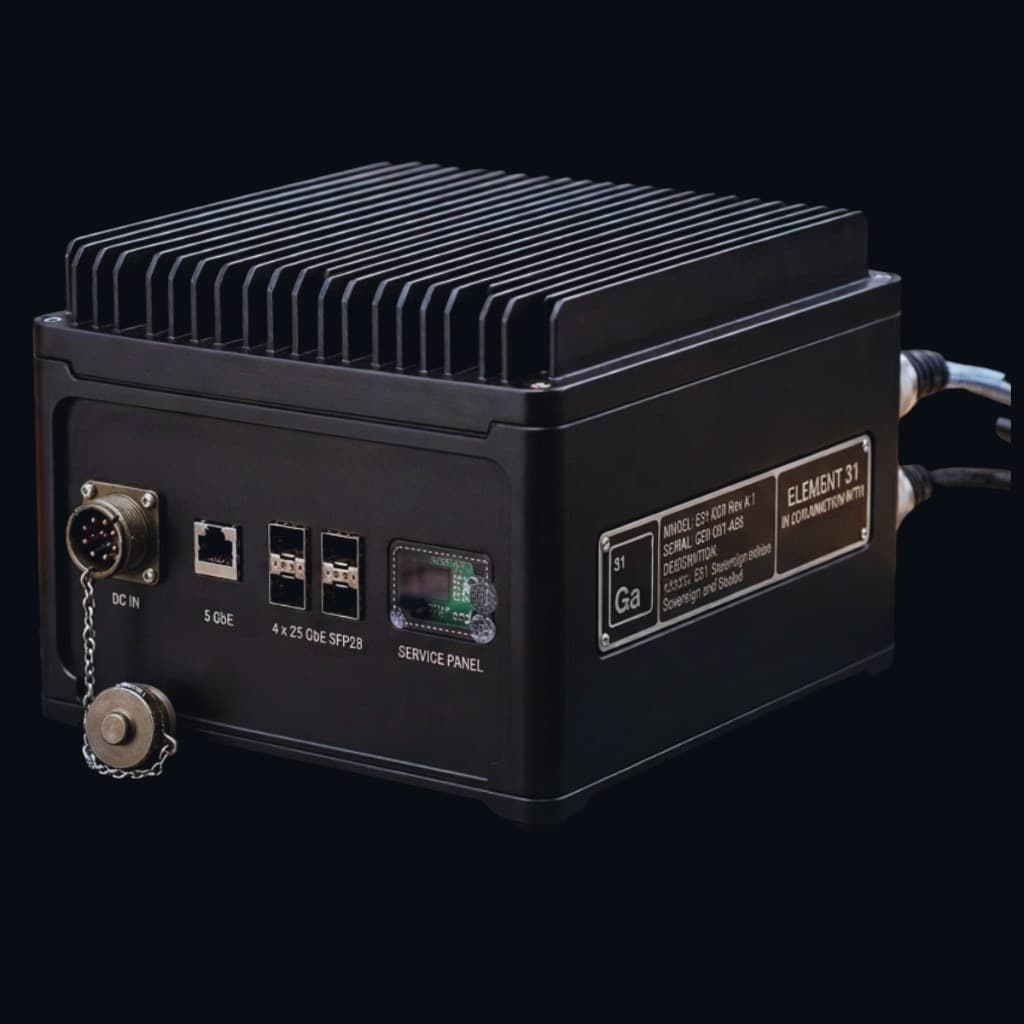
FIRST LOOK
The unit itself.
Rev A hardware in the fixed-site configuration. A single-workload build of the same sealed enclosure family, tuned for code-model inference and repo indexing rather than general training.
- DC IN
- Locking circular power connector with a captive dust cap — one feed, no external supply logic.
- 5 GbE
- Copper uplink for enclave LAN access, governed by default-deny egress — the only path your IDEs and CI runners need.
- 2× 25 GbE SFP28
- Fiber cages for bulk repository ingest — full monorepo clones and history walk in at line rate during initial indexing.
- SERVICE PANEL
- Tamper-evident window, sealed at final assembly. Field and extreme tiers ship without serviceable openings.
- PASSIVE COOLING
- A lighter fin stack than the training-class enclosure — fanless conduction sized to a single-workload thermal envelope.
OVERVIEW
Your code never leaves the room.
Forge is the coding tier of the Element 31 hardware line — one of three sealed appliances, alongside Czar for training custom models and Chassis for bespoke resale deployment. It is built to do one job well: answer coding questions against your actual codebase, without ever sending a line of that codebase to a service you do not control. The model, the repository index, and the retrieval layer all live inside the enclosure. Nothing about how it answers depends on a connection to the outside world.
That constraint is the whole point for teams carrying proprietary source, export-controlled IP, or ITAR-regulated code — the categories of source that public Copilot-style tools and cloud LLMs are structurally unable to guarantee. Forge is provisioned with your repositories before it ships, sealed before it leaves, and indexes new commits locally from then on. Compute is selected specifically for low-latency code-model inference and fast local retrieval, not general-purpose training, so the enclosure runs lighter and cooler than a training-class appliance while staying in the same Jetson-AGX-Thor-class compute family as the rest of the E31 line.
SPECIFICATIONS
What is in the box.
- Compute
- NVIDIA Jetson AGX Thor (T5000)
- GPU architecture
- NVIDIA Blackwell
- Unified memory
- 64 GB
- Storage
- Up to 2 TB NVMe, encrypted
- Power draw
- Under 100 W typical
- Networking
- Multi-gigabit; air-gap capable
- Cooling
- Fanless conduction (sealed configuration)
- Enclosure
- Machined aluminum, sealed, tamper-evident
- Environmental
- Ruggedized; tiered for indoor, field, and extreme deployment
- Origin
- US integration, sealing, software load, and final assembly
- Software
- E31 Substrate — code model, repo index, and retrieval, preloaded and sealed
Specifications subject to configuration. Detailed engineering documentation available under NDA.
CONFIGURATION TIERS
Three builds, one architecture.
The software, the sealing discipline, and the API are identical across tiers. What changes is what the enclosure is built to survive.
Fixed Site
- ENVIRONMENT
- Conditioned indoor space — a dev floor, secure facility, or SCIF-adjacent workroom.
- SEALING
- Sealed enclosure with tamper-evident closure, on standard facility power.
- USE CASE
- Engineering teams whose repositories cannot cross an enclave boundary.
Field
- ENVIRONMENT
- Mobile and forward development locations with temperature swings, vibration, and dust.
- SEALING
- Sealed and fanless, with no service openings once deployed.
- USE CASE
- Deployed engineering teams and contractor sites that relocate on short notice.
Extreme
- ENVIRONMENT
- Uncontrolled conditions at the limits of temperature, shock, and contamination.
- SEALING
- Fully sealed and hardened; the enclosure is not opened after final assembly.
- USE CASE
- Austere development sites and contested locations with no maintenance reachback.
SEALED BY DESIGN
Your source is the asset. It is treated like one.
Sealed enclosure
The chassis closes once, at final assembly. The sealed configuration has no field-serviceable openings.
Tamper-evident construction
Physical interference with the enclosure leaves permanent, inspectable evidence. Nothing depends on trusting the shipping path.
Signed, read-only software image
The code model and retrieval stack are signed and mounted read-only. Nothing is installed, patched, or altered in place at runtime.
Continuous integrity verification
The appliance re-checks its own image and tamper indicators while running. Deviations are written to an append-only record.
DEPLOYMENT POSTURES
How it sits on your network.
ENCLAVE
On-premise, no internet
The appliance sits on your internal network with no route to the public internet. Engineers reach it the way they reach any other internal dev tool.
TACTICAL
Disconnected, syncs on reachback
The appliance operates fully disconnected for the duration of a deployment. When a trusted link is available, repository updates and records move in one controlled exchange.
FULL AIR-GAP
Offline provisioning only
No network path exists in either direction. Repository loads and model updates cross the gap as signed bundles on physical media.
THE E31 HARDWARE LINE
Forge is one of three.
Same sealed, tamper-evident hardware family. Each appliance is spec'd for a different job.
CZAR
Train and fine-tune your own models.
The sovereign AI sandbox for custom and proprietary model development on sensitive internal data — sealed, on-premise, fully yours.
CHASSIS
Bespoke hardware, built to resell.
Custom-made, built-to-order hardware manufactured to a specific customer deal, for orgs that resell the appliance downstream under their own brand.